
Caring for Air Plants
 Adams Fairacre Farms
 Air plants, also known as tillandsias, are unusual houseplants because they do not need traditional potting soil. In nature, many tillandsias grow attached to trees, rocks, and other surfaces. They absorb moisture and nutrients through their leaves instead of relying on a large root system.
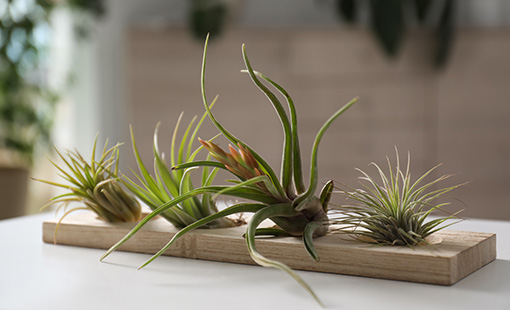
Because of this, air plants are easy to display in creative ways. They can be mounted on driftwood, tucked into decorative holders, grouped in glass-free displays, or arranged with shells and stones. The key is to give them bright light, regular moisture, and plenty of air movement.
Air Plant Growing Conditions
- Light: Bright light, but not direct. A south, east or west window is perfect. They can also be grown under fluorescent light.
- Water: Water 2 to 4 times a week with a mister. If your environment is dry, mist daily. Water until the plant is saturated.
- Temperature: Some varieties can withstand near freezing temperatures, but most will thrive between 70 F and 85 F. High humidity is a bonus.
- Support: Glue tillandsias to cork, coral, stone or driftwood. Only a few varieties can adapt to soil.
- Fertilizer: Use a low-copper liquid fertilizer, diluted to 1/4 strength. Feed monthly.
Air Plant Propagation and Mounting
Propagation
Tillandsias reproduce by putting out offsets, or pups, from the base of the mother plant. When the pups are half the size of the mother, they can be divided and mounted on their own. Tillandsias can also be grown from seed, but this is a slow process that might take years.
Mounting
Tillandsias prefer to be mounted on a solid substrate that does not retain water. You can glue your tillandsia directly to the surface with a strong adhesive, or you can wire the plant to the base. Don’t cover the base of the plant with moss or it may rot. Tillandsia can be grown on almost any imaginable decorative mount, including shells, rocks, slate, driftwood, etc. Group them in decorative clumps for maximum effect. Two varieties—T. cyanea and T. lindenii—can be adapted to soil.
Grower’s Tips
Tillandsias can be wonderfully rewarding plants—their leaves often blush amazing colors before a bloom. A well-kept collection looks like a healthy coral reef. The most common mistakes made with tillandsia are not providing enough water and overfertilizing. If the leaves start to curl under, the plant is likely gasping for water. Submerge it overnight in the kitchen sink and it will come back. Finally, like epiphytic orchids, they require lots of fresh air, so don’t suffocate the plants with moss.
Air plants are also fun to collect because different varieties have very different shapes, colors, and textures. Some stay small and compact, while others grow long, twisting leaves. Many develop brighter color as they prepare to bloom.
For best results, check your air plants weekly. Look at the leaves, feel the weight of the plant, and make sure it is drying properly after watering. Once you learn how they respond in your home, their care becomes much easier.
Visit Adams for Air Plants and Houseplant Supplies
Looking for air plants, houseplants, or indoor plant care supplies? Visit Adams in Poughkeepsie, Newburgh, Middletown, Kingston, or Wappingers Falls. Our houseplant selection includes unique indoor plants, pottery, soil, fertilizers, and care essentials.
Information adapted from TheSpruce.com